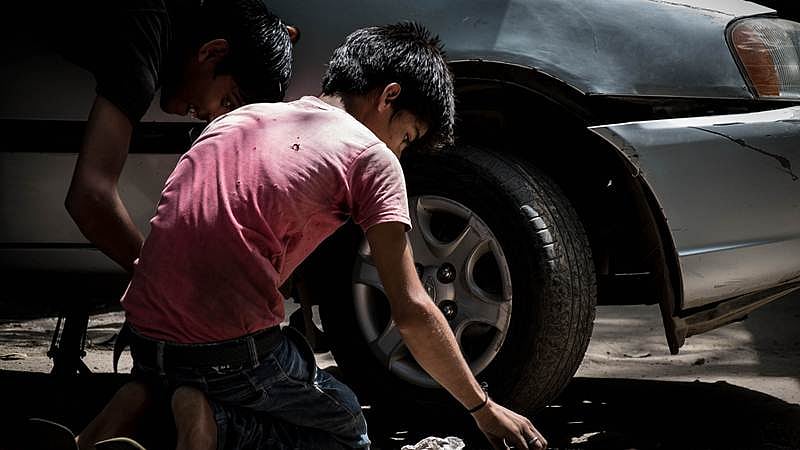
Mumbai, Feb 27: Young girls and boys, some as young as eleven, in Dharavi’s garment and leather units work 12-hour shifts in congested rooms, as poverty and safety concerns drive families to push minors, especially girls, into these workshops instead of school.
Several garment and leather units in Dharavi continue to employ children for manual labour. Many work in 10-by-10 rooms with little ventilation, often spending long hours stitching, sorting and handling fabric in unsafe and unhygienic conditions.
Parents cite necessity and safety
Parents say the decision is driven by necessity and fear. In households with unstable incomes, even small earnings from a child are seen as vital. For young girls, families often view the workshop environment as “safer” than the streets. Several units arrange basic pick-up and drop-off, leading guardians to consider them safer havens where children remain occupied and supervised.
A parent, requesting anonymity, justified sending her niece to work. “My niece failed twice in the fifth standard and bluntly refused to continue her studies. In Dharavi, children go down the wrong path very easily. I was worried for her. Eventually, we need money also to survive in this city,” she said.
She considered factories a “safe place” for young girls, adding, “They have a pick-up and drop-off facility which makes their travel safe. She is a girl and needs to do household chores after marriage. She is doing this job, which will help her in life.”
Poverty and social acceptance
Child labour in Dharavi has become a mix of poverty and social acceptance. “There are mixed cases of child labour in Dharavi. Parents who see their children unable to cope with studies start sending them to work. The money is meagre, but it’s vital for them,” another parent from Dharavi said.
“Relatives from Dharavi often convince families to send their children to work, especially in small-scale industries. Many of these children come from nearby slums, and parents often fall prey to easy money,” the parent added.
Most of these workshops have makeshift toilet enclosures. Children eat, sleep and sometimes bathe in the same rooms where they work, indicating the hardships they choose over studies and formal education.
Similar patterns are reported across garment workshops in Dharavi and adjoining slum clusters such as Govandi, Madanpura, Nagpada and Ulhasnagar. Boys between six and fourteen are commonly found sewing beads and coloured threads. Girls are pushed into intricate zari work.
Regulatory gaps and redevelopment hopes
Parents often justify the decision by citing poor academic performance, the risk of children going astray and the need for additional income. Officials and social workers, however, acknowledge that the issue persists partly due to regulatory gaps.
While child labour in hazardous industries triggers immediate legal action, garment units classified as “non-hazardous” fall into loopholes. Children aged 14 to 18 years are legally allowed to work under certain conditions, but minors below 14 continue to be employed in hidden, unregistered units.
Also Watch:
As Dharavi undergoes a major redevelopment push, experts say the clean-up could help curb child labour, provided the project includes regulated commercial zones and improved living conditions. Better infrastructure and a healthy environment could limit the operations of illegal workshops that function behind closed doors at present.
To get details on exclusive and budget-friendly property deals in Mumbai & surrounding regions, do visit: https://budgetproperties.in/